
Table of Contents:
Prepare Ahead to Reduce Exam Anxiety
With final exams approaching soon, starting to prepare ahead of time will increase grades and reduce anxiety.
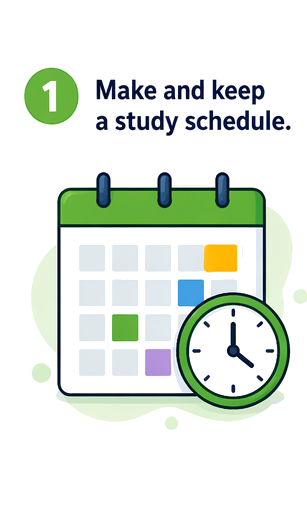
1. Make and keep a study schedule
Set aside certain hours each day for homework and test review. Keep the same schedule during the week and create a weekend schedule.

2. Study in a suitable place: the same place every day
Is concentration one of your problems? Experts tell us that the right surroundings will greatly help you concentrate. Your study desk or table should be in a quiet place, as free from distractions as possible. You will study better if you study in the same place every day.

3. Collect all the materials you will need before you begin
Your study area should have everything you need, such as paper, a pen, an eraser, and a highlighter. With all your materials at hand, you can study without interruption.
4. A well-kept binder can help raise your grades
Research shows that there is a definite relationship between the organization of a student’s binder and the grades s/he makes. Being able to find notes quickly saves time.
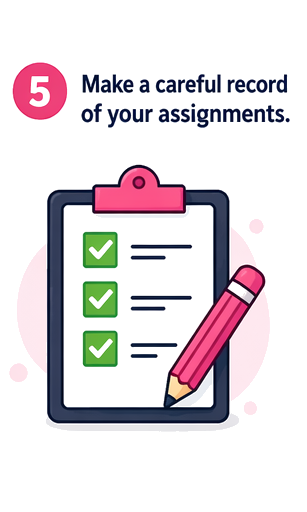
5. Make a careful record of your assignments
Why lose time texting friends to find someone who knows the assignment? Write it down in your planner. Knowing just what you are expected to do and when you are expected to do it is the first long step toward completing important assignments successfully.

6. Use “trade secrets” for successful studying
- Graphic organizers and mnemonics are “magic helpers”
- The “divided page” is another trick of the study trade. Make a dividing line down the center of a sheet of paper. Then write important questions on the left side and the answers on the right. Cover the right side and try to give the answers. Then check and recheck until you are sure you know the material. (One can use the SQ3R organizer for this study technique.)
- Use a “cover card”. As you study, read over your notes or textbook and read what you are trying to memorize. Then use your “cover card” to cover what you have just read. Try saying out loud or writing the facts from memory until you have memorized the facts.
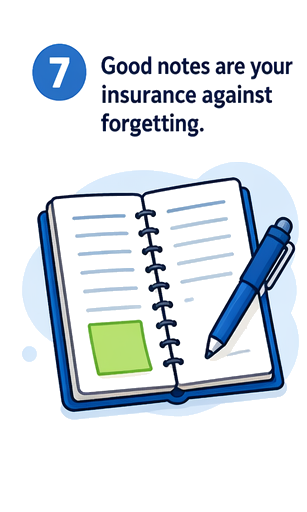
7. Good notes are your insurance against forgetting
Having good notes is a “must” for reviewing before tests. Without notes, you will often need to reread the whole assignment. With notes, you can review the main points in your mind in just a fraction of that time. The time you spend taking notes is not time lost, but time saved!

8. How can I remember what I have studied? One secret of remembering is “overlearning”
In an experimental study, students who “overlearned” the material remembered four times as much after 28 days had passed. This means taking time to review notes starting weeks before the final exam, and setting aside time each week to review.

9. Frequent reviews will pay off in knowledge and grades
Without continual practice, the average student can forget 80% of what s/he reads in just two weeks! Your first review should come very shortly after you read over the material for the first time. The early review stops memory loss and helps you remember longer. Frequent review will make a difference when preparing for tests and exams and help you get higher grades.

10. Don’t wait for inspiration to strike – it probably won’t
We can learn a lesson about studying from observing an athlete. Can you imagine seeing an athlete training for a mile run sitting on the field, waiting for inspiration to strike before he starts practice? He trains hard day after day, whether he wants to or not. Like the athlete, we get better at test preparation by practicing the things we are expected to do over a long period of time.
People often wish “good luck!” when they hear you have finals coming up, but you won’t need “luck”…Use these 10 helpful tips to prepare and study more effectively, and you will do better than ever on your final exams!